
Guernsey County Projected Release Meaning
A projected or expected release date is a forward-looking calculation. It is not a promise that a person will leave a named door on that day. ODRC uses the combined label “Expected Release Date/Parole Eligibility Date.” The legal meaning shifts with the sentence. For a definite term, the date can reflect the computed sentence endpoint. For an older parole-eligible or life sentence, it may mark eligibility for Board review rather than guaranteed release. For a qualifying Reagan Tokes indefinite term, the minimum term can create a presumptive point while the maximum term remains relevant.
A person held before trial is different. With no sentence to compute, bond, dismissal, plea, trial, or another court order controls when county custody may end. A local jail sentence also is not governed by ODRC prison-credit rules. Ask the Guernsey County Jail and sentencing court for the local commitment and release calculation.
The word “release” also can hide a transfer. Movement from Guernsey County Jail into ODRC custody removes the person from the county roster but does not return the person to the community. Verify state intake before describing that event as a community release.
Find Guernsey County Projected Release Dates
Begin by sorting the person into one of three groups: pretrial county custody, a sentenced county-jail term, or an ODRC prison term. That choice prevents a state search from being used for someone who never entered state prison. It also prevents an active jail roster from being treated as a release-date calculator.
- Gather the full name, date of birth, case number, booking number, or ODRC number.
- For an ODRC case, search by number when possible and verify Guernsey as the committing county with the docket and offense.
- Read the aggregate sentence, jail-time credit, mandatory parts, and the exact “Expected Release Date/Parole Eligibility Date” label.
- Decide whether the date is a definite-term endpoint, presumptive point, or parole eligibility date.
- Review any parole hearing, transitional control, or supervision fields shown on the record.
- For county custody, obtain the commitment and calculation from the jail and sentencing court.
- When records conflict, contact the ODRC Bureau of Sentence Computation and use the sentencing entry.
The official ODRC expected-release example shows the combined date label and sentence context used by the state.
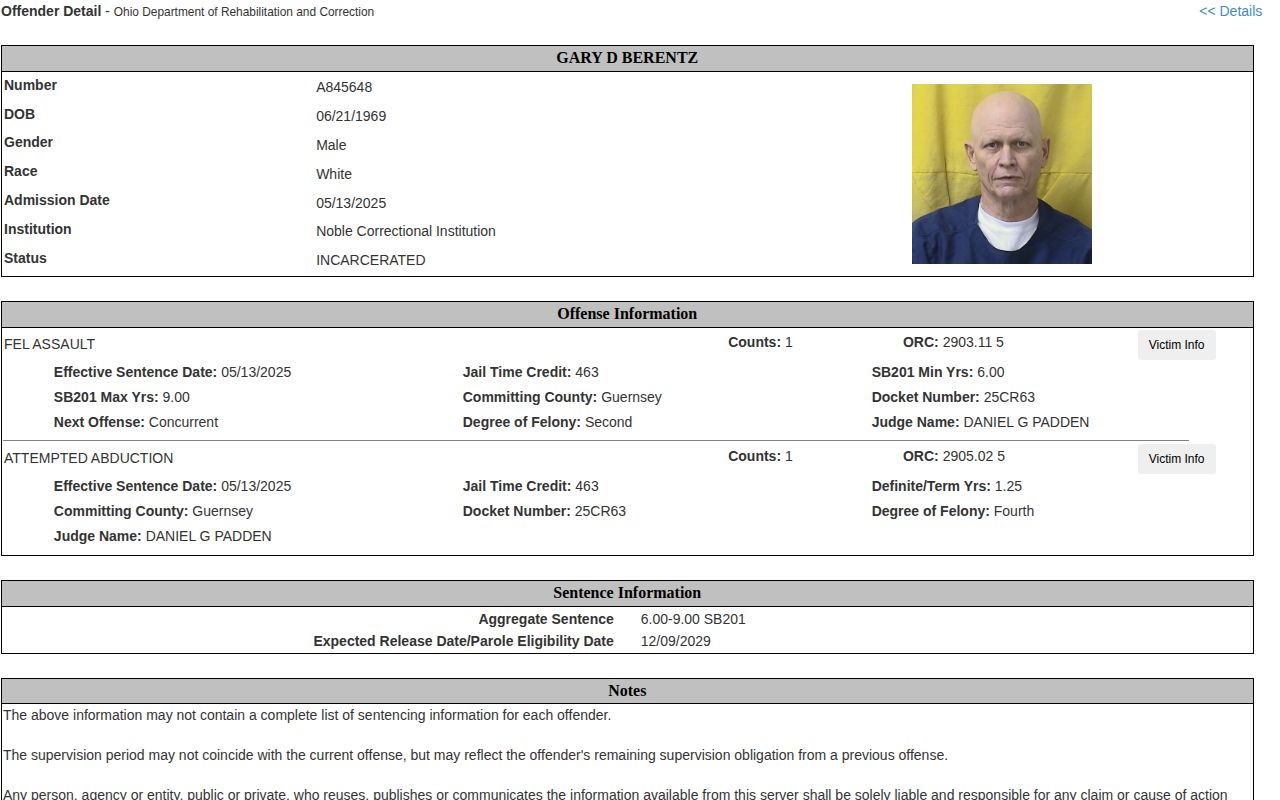
The capture shows why the date must be read with the sentence and parole fields. The label does not mean the same thing in every Ohio case.
Note: Search by ODRC number when available because a name-only result can confuse people who share similar names or birth information.
Guernsey County ODRC Release Fields
The ODRC Offender Search is the strongest public portal for a person who entered Ohio prison or Adult Parole Authority supervision. It can be searched by last name, first name, ODRC number, county of commitment, residential county, status, and related filters. A county bond release or completed local jail term may never appear there.
Open the detail record and compare the name, date of birth, ODRC number, committing county, docket, and offense. The state result can also show admission date, institution or supervision location, jail-time credit, sentence parts, judge, aggregate sentence, hearing data, and a correctional photograph. Status supplies a separate clue: INCARCERATED means state prison custody; APA SUPERVISION means outside prison under Adult Parole Authority control; RELEASED can include qualifying text that must be read in full.
| ODRC field | Use in a release-date check |
|---|---|
| ODRC number | Best key for matching one state record |
| Committing county and docket | Connects the state term to the Guernsey court case |
| Aggregate sentence | Shows the combined sentence structure reported by ODRC |
| Jail-time credit | Shows credit reported toward the state calculation |
| Expected Release Date/Parole Eligibility Date | Provides the projected endpoint or eligibility point, depending on sentence |
| Hearing and supervision fields | Shows later decision points or post-prison control when applicable |
The ODRC definition page distinguishes several other labels, including parole on or after, projected release date, sentence expiration tied to a halfway-house path, earliest possible transitional-control transfer, and expiration of supervision. These terms should not be exchanged as if they all mean physical release.
When the public detail is not enough, ODRC Central Records is the state record channel. R.C. 5120.21 requires a record of entrance or commitment and the date, cause, and terms of discharge, condition on leaving, and transfers. Ask for the releasable discharge or sentence-computation record by full name and ODRC number. The statute does not make the complete inmate or APA file public, so a focused request is more accurate than asking for unrestricted access.
Guernsey County Earned Release Credit
For current qualifying Ohio prison confinement, R.C. 2967.194 governs earned credit on and after April 4, 2024. Eligible prisoners can receive provisional credit tied to productive participation in qualifying programming. The statute uses one or five days for each completed month, depending on the category. Certain program completions may yield 90 days or 10 percent of the sentence, whichever is less. Ordinary participation and completion credits in one division have an aggregate 15 percent cap, while another completion-award division is treated separately.
Eligibility limits are broad. Nonreducible terms, life without parole, murder categories, some sexually oriented offenses, and other mandatory or offense-specific terms can be excluded. Credit also may be denied or withdrawn for conduct. On eligible indefinite terms, the law applies credit to both the minimum and maximum terms. The prior framework in R.C. 2967.193 cannot simply be applied to current confinement.
Sentence credit is only one input. Jail-time credit, concurrent or consecutive terms, mandatory specifications, and amended entries all shape the calculation. ODRC warns that the public record may not display every part of sentencing history. For a disputed figure, use the court’s sentencing entry and contact the Bureau of Sentence Computation.
ODRC Bureau of Sentence ComputationP.O. Box 2650
Columbus, OH 43216
614-466-3749
Why Ohio's 85% Shortcut Fails
Ohio does not have one rule that every prisoner serves 85 percent. That shorthand turns one cap within one part of the credit framework into a promise it cannot support. The current statute has different credit rates, completion awards, eligibility classes, caps, exclusions, and conduct rules. Some terms cannot be reduced through that route at all.
Other sentence types add separate decision points. Under R.C. 2967.271, a qualifying Reagan Tokes indefinite sentence uses a minimum term and rebuttable-presumption process while retaining a maximum term. Parole-eligible categories follow R.C. 2967.13 and Board review. Judicial release follows R.C. 2929.20 with its own limits. None can be reduced to one universal percentage.
No official Guernsey County jail good-time formula was verified. No local weekend-advance policy was found either. If a county sentence appears to end on a weekend or holiday, ask for the actual release entry. Do not promise a Friday exit or apply ODRC earned-credit law to a county-jail term.
Guernsey County Release Date Changes
A future date can move because the underlying calculation or legal status changes. Some changes shorten the expected term. Others delay a possible release or redirect the person to another custodian. The updated record and order control, not an older screenshot or saved date.
| Factor | Possible effect | Best record to check |
|---|---|---|
| Jail-time credit correction | Moves the computed sentence endpoint | Sentencing entry and ODRC calculation |
| Concurrent or consecutive treatment | Changes how multiple terms combine | Final sentencing entry |
| Earned credit award or withdrawal | Shortens or restores time within statutory limits | ODRC sentence computation |
| Judicial release | Allows court-authorized early release when eligible | Common Pleas docket and order |
| Parole grant, denial, or rescission | Changes a Board-controlled release path | ODRC hearing result and official minute |
| Detainer or outside warrant | May transfer custody instead of returning the person to the community | Release disposition and receiving agency record |
| Clerical or amended entry | Corrects the public calculation | Amended court entry and ODRC update |
ODRC’s database has a statutory 24-hour update cycle under R.C. 5120.66, but that does not guarantee that every legal development appears at once. It also does not apply to the Guernsey County jail vendor’s active list. When a date changes without a clear reason, compare the latest court entry and ask Sentence Computation about the current state figure.
Note: A detainer can cause a custody transfer on the expected date, so release from one agency may not mean release to the community.
Guernsey County Jail Release Dates
For a local jail sentence, contact the Guernsey County Sheriff’s Office and the sentencing court. Ask for the commitment, jail-time credit, calculated end date, and final release event. The jail line is 740-432-2955. A written public-record request can ask for the admission and release date and time, disposition, and destination if the person moved to another agency.
Court level matters. Cambridge Municipal Court handles misdemeanors and preliminary felony work. Guernsey County Common Pleas controls indicted felony cases and state-prison sentences. A pretrial bond entry may explain why custody was expected to end, but the sheriff’s release record establishes the physical county event. A prison conveyance entry explains why the person left the jail while remaining in custody.
The complete county search and record-request sequence appears in the Guernsey County released inmate lookup. Use that path when no state sentence exists or the question concerns the actual jail exit rather than a projected prison date.
Confirm Guernsey County Actual Release
Return to the official record on or after the expected date. For ODRC, read the status, release detail, and any APA supervision field. APA SUPERVISION means the person has left the institution but remains under correctional supervision. RELEASED may include text that qualifies how the state record ended. For county custody, obtain the jail’s final release entry and compare the court docket.
VINELink can provide a pending event alert from participating agencies. Registration is tied to one matched person and can offer telephone, text, or email channels. The alert should still be checked with the jail or ODRC. The Guernsey County VINELink check explains the matching, PIN, confirmation, and agency-verification steps.
Keep the projected date and actual event separate in notes. Record when each source was checked. If the person was transferred, name the receiving custodian rather than calling the event a community release. That final distinction is often the difference between a useful record and a mistaken conclusion.