
Understanding Guernsey County Releases
A release from Guernsey County Jail is a custody event tied to a booking. It is not just a missing name. The Guernsey County Sheriff’s Office Corrections Division calls its public list an active-inmate listing. A person usually drops off that list after the jail stops treating the booking as active, but the reason may be bond, a court order, time served, completion of a local sentence, or transfer. The underlying booking and release record should identify the event more precisely.
Words matter here. A community release means the person left confinement, though a case or supervision may continue. A transfer means another agency took custody. Transport to the Ohio Department of Rehabilitation and Correction, often shortened to ODRC, is not freedom from custody. A warrant from another county can lead to another transfer. The ordering court’s docket explains the legal authority, while the sheriff’s record establishes the county jail’s physical release or handoff.
- Bond
- A financial or court-approved pretrial release while the case continues.
- Time served
- A sentence satisfied by time already spent in custody or by completion of the imposed jail term.
- Probation
- Court-ordered community supervision, often called community control in an Ohio felony case.
- Parole
- Release authority for certain prison sentences, followed by supervision through the Adult Parole Authority.
- Discharge
- The end of the correctional status described by the responsible agency, not merely exit from one building.
Guernsey County Release Paths
Guernsey County released inmates do not all move into the same status. The likely next record depends on the court order and destination. A person who posts bond may still have hearings ahead. Someone sentenced to Ohio prison enters ODRC custody and appears in the state system after intake. A local probation sentence remains tied to the court and probation office. The following distinctions prevent a roster change from being mistaken for proof of freedom.
| Custody exit | What it means | Best next record |
|---|---|---|
| Bond or recognizance | Pretrial jail custody ends while the case ordinarily stays open. | Sheriff release record and Municipal or Common Pleas docket |
| Dismissal or acquittal | A court disposition ends the charge or produces release, subject to any other hold. | Court journal entry plus sheriff release record |
| Time served or local term complete | The court credits or completed jail term supports a community release. | Sentencing entry and jail release record |
| Probation or community control | The person leaves custody under court supervision. | Court docket and the proper probation office |
| ODRC transport | State custody begins after a prison commitment. | County transfer entry followed by ODRC intake record |
| Other-agency transfer | A warrant, detainer, or receiving agency keeps custody in force. | Release destination and receiving-agency record |
Can a person be released but still under correctional control? Yes. Bond conditions, probation, post-release control, or parole can continue outside the jail. Read the full status and the court order.
Guernsey County Release Record Fields
A focused Guernsey County release record request should identify the person and the booking, then ask for the event fields that answer what happened. Public portal labels can vary, and the research did not verify every code used by the jail vendor. The safest method is to ask for existing fields by meaning instead of asserting an unsupported code. A useful response can be compared with the court docket and, if prison transport occurred, the ODRC detail record.
| Field | What it shows |
|---|---|
| Subject and booking number | Connects the event to the correct person and jail admission. |
| Admission date and time | Marks when the jail accepted the person for that booking. |
| Release date and time | Records the jail’s custody-ending event, if time is maintained. |
| Release disposition or type | May distinguish bond, court order, sentence completion, or transfer. |
| Releasing authority | Identifies the court or agency authority behind the event. |
| Destination or receiving agency | Shows whether the person entered another agency’s custody. |
| Associated booking image | Links the requested photo to the same booking, but does not itself prove release. |
The legal event and physical exit may have different timestamps. A judge can sign an order before staff complete release processing. The court record proves what was ordered. The jail record shows when the county custody event was carried out.
Request Guernsey County Release Records
The sheriff’s contact and public-record-request page is the documented written route. Ask for a defined record and date span, not an answer to the broad question of whether someone is free. Ohio law does not set one fixed response deadline or one universal fee for every request. Inspection must be prompt during regular business hours, while copies must be supplied within a reasonable period at actual cost, plus permitted delivery cost.
- Gather the full name, approximate booking date, case number, and booking number if known.
- Choose the public-record-request reason on the sheriff form and state the desired delivery method.
- Request admission and release times, disposition, release type, receiving agency if releasable, booking number, and associated booking image.
- Ask for the legal authority for any withheld part. If the record no longer exists, request the applicable retention-schedule series.
- Save the response and compare it with the controlling Municipal or Common Pleas entry.
601 Southgate Parkway
Cambridge, OH 43725
Jail: 740-432-2955
Dispatch: 740-439-4455
Fax: 740-432-3916
Email: contactus@guernseysheriff.com
Phone contact can help identify which record exists, but the written response is stronger proof. No fixed local copy fee or guaranteed turnaround was published. If a request is too broad, Ohio’s Public Records Act calls for an opportunity to revise it based on how the office keeps its records.
The official Sheriff request page shows the form and contact channels available for a Guernsey County release-record request.
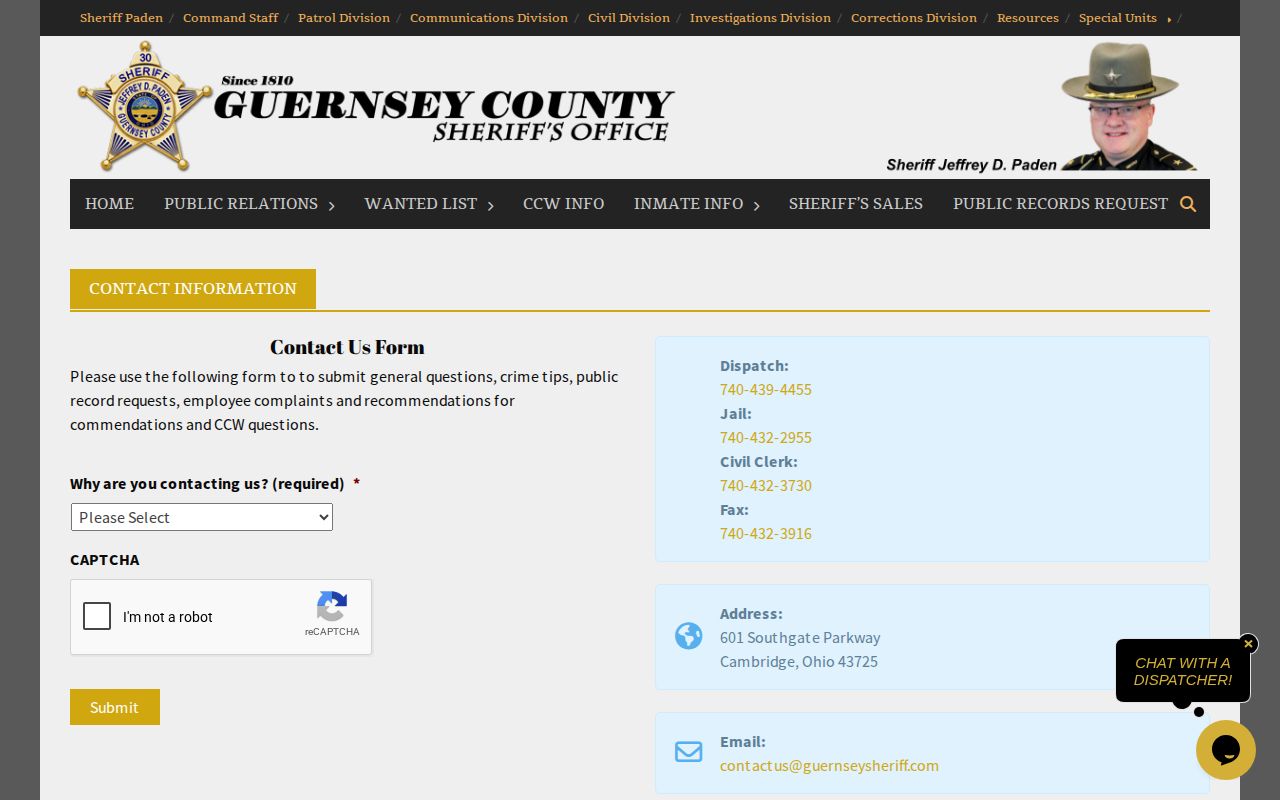
The form’s public-record option provides a written path when the active roster no longer displays the booking.
Note: Request the releasable record because medical, juvenile, investigatory, supervision, sealed, and expunged material may be restricted.
Guernsey County Release Record Law
Ohio Revised Code 149.43 is the starting point for county public records. It calls for prompt inspection and copies within a reasonable period, permits actual copy and delivery costs, and requires a legal basis for denial. Exempt parts of a mixed record should be redacted when the rest can be released. It does not guarantee every part of a jail, parole, probation, or investigative file.
Sealing and expungement can change public access. Ohio Revised Code 2953.31 through 2953.34 covers official records, including photographs, and can require restricted access, deleted index references, or destruction to the statutory degree. Eligibility turns on the case, offense, and final discharge. A missing old record does not prove there was no booking.
Guernsey County Bond Release Proof
A Guernsey County bond-out must be kept separate from sentence completion. Cambridge Municipal Court says it receives filings from all law-enforcement agencies in the county. Its docket is therefore the logical first court check for a misdemeanor bond or the preliminary stage of a felony. A bond entry can show that pretrial custody was ordered to end, but it does not close the case and may carry conditions.
If a felony is indicted or bound over, follow the matter into Guernsey County Common Pleas. The sheriff’s release record supplies the physical custody event, while the docket supplies the legal basis. Searching both avoids treating the end of a preliminary municipal entry as the end of the prosecution. It also helps distinguish release on bond from later sentencing, probation, or transport to prison.
Guernsey County Release Scale Context
The sheriff publishes dated operational figures that give local context without measuring present releases. In 2018, the Corrections Division reported that 2,523 people were held, including 1,812 men and 711 women, and listed an average daily population of 104. Those are historical held-population figures. They are not a current booking count, not a current population count, and not an annual total of Guernsey County released inmates.
Year labels are essential. The figures explain the facility’s past operating scale, but only a record request for a defined period can establish how many release events occurred in that span.
Guernsey County Release Property Rules
The jail’s published property language is unusually narrow. The Corrections Division says inmate property generally is not released until transport to prison. It identifies an exception for food cards in the name of the person collecting them, with pickup windows from 9:00 to 11:00 a.m. or 8:00 to 10:00 p.m. Approved medication and eyewear use a separate medical contact at 740-439-6339 from 8:00 a.m. to 4:00 p.m.
These rules describe property handling around a prison transfer. They do not publish a general release desk schedule, a gate-out hour, or a time for families to wait. No official source reviewed identified a routine transport service or designated family waiting zone for every person released. Confirm the person’s custody event with the jail before using a property pickup window as a sign of release.
The Sheriff’s Corrections Division page shows the source material behind this distinction.

The county page separates property and medical pickup rules from the status of the person in custody.
Find Guernsey County Released Inmates
The right search starts with identity and likely custodian. Gather the full legal name, approximate date of birth, custody dates, and a booking, ODRC, or case number if known. Then follow one custody path from start to finish. The sheriff record, court docket, and state or federal locator answer different questions, so a no-match in one system should not be stretched into a conclusion about another.
- Check the sheriff active portal only to determine whether the person appears in current Guernsey County Jail custody. No match does not prove release.
- Request the county booking and release record, including disposition and destination. This is the best direct proof of the jail event.
- Read Cambridge Municipal Court for misdemeanors and preliminary felonies, then follow an indicted felony to Common Pleas.
- If the record shows prison transport, search ODRC by number or name and verify Guernsey as the committing county.
- Use Ohio VINELink for a custody event or future alert, then confirm the notice with the sheriff or ODRC.
- Use BOP only for federal custody and ICE ODLS only for immigration detention. Neither explains an ordinary county bond release.
A person-specific search needs one more safeguard: match the docket, identifier, and agency before accepting the result. Similar names can occur, and a state record belongs to someone who entered state custody, not every person once held at the county jail.
ODRC Guernsey Release Search
The Ohio DRC Offender Search is the strongest online route when a Guernsey County case led to state prison or Adult Parole Authority supervision. It is not a county bond-release archive. Search by ODRC number when possible. Otherwise use the name and filters, open the detail page, and compare date of birth, committing county, docket, offense, and sentence.
| Search field | How it helps | Limit |
|---|---|---|
| ODRC number | Provides the most direct match to a state record. | Applies only after entry into ODRC or APA records. |
| Last and first name | Finds candidates when the number is unknown. | Requires identity checks for similar names. |
| County of commitment | Helps isolate a Guernsey County sentence. | Residential county may differ after release. |
| Status | Separates incarcerated, APA supervision, and released categories. | Read all qualifying text after the status word. |
“INCARCERATED” means state prison custody. “APA SUPERVISION” means the person is outside the prison institution but remains under state correctional supervision. “RELEASED” is not enough by itself because qualifying text can change its meaning. One official Guernsey commitment example reads “RELEASED - Death,” which shows why the whole status line must be read. An expected release or parole eligibility date is prospective, not proof that the exit occurred.
The official ODRC search screen illustrates the state-specific fields used for Guernsey County released inmate lookup.
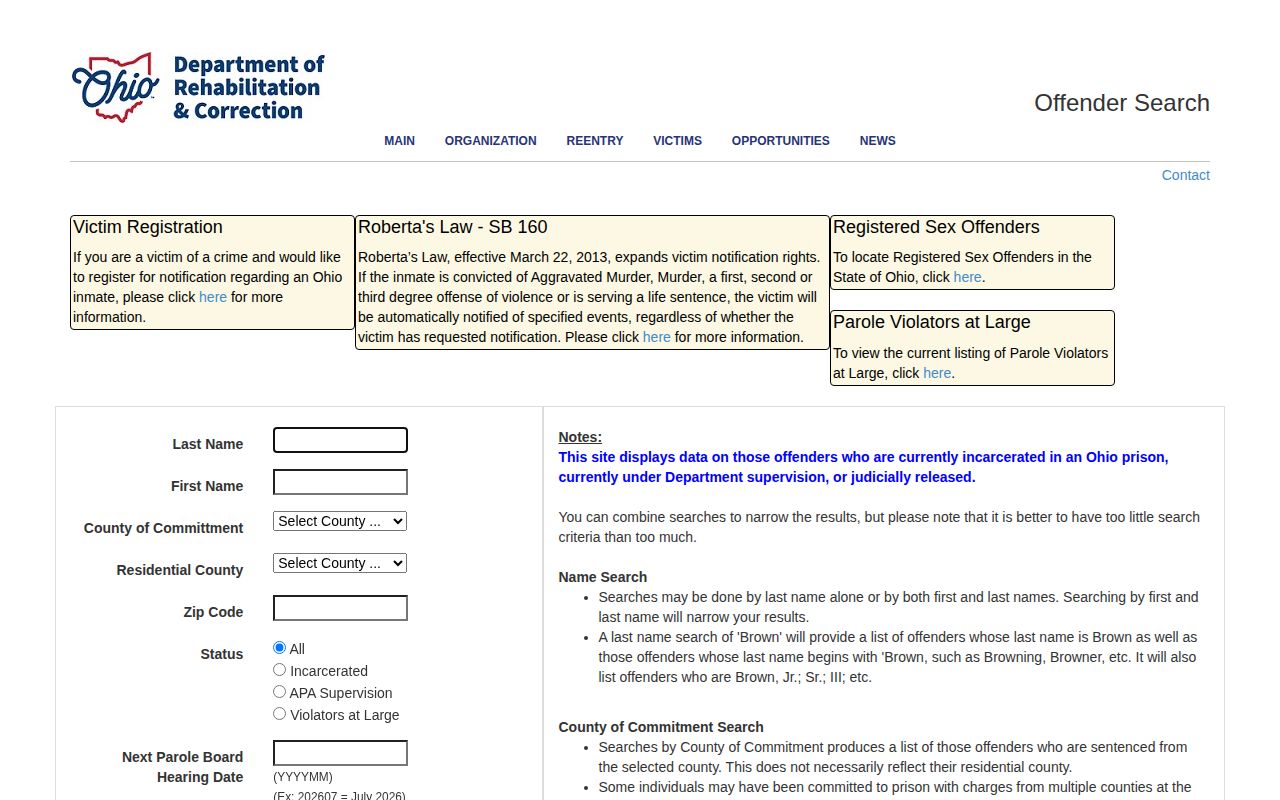
Use the result detail, not the search-list name alone, to verify the ODRC number, county, docket, and full correctional status.
Guernsey County Recent Release Gap
No separately labeled official 24-hour or 72-hour release feed was found on the Guernsey County Sheriff site or its linked 365Labs portal during the July 31, 2026 research sweep. The county portal is described as an active-inmate list. It should not be renamed or presented as a historical release list. For a same-day or three-day span, submit a bounded request for release events between exact timestamps.
The vendor implementation can support settings related to date of birth, booking number, imagery, release-date display, and downloads, but that does not prove each field is public on every card. The sheriff publishes no numeric refresh interval and no former-inmate retention window. Record what a live card shows, then seek the underlying record for the event. The first-party sheriff app can supplement current jail information, but its store descriptions do not promise a recent-release window.
Note: A roster comparison is only a lead because it cannot distinguish bond, dismissal, prison transport, another hold, or data correction.
Guernsey Release Court Follow-Through
Two-court follow-through is essential in Guernsey County. The Cambridge Municipal Court case search covers misdemeanors, traffic cases, and preliminary felony proceedings. Its annual report states that filings come from all county law-enforcement agencies. A sheriff arrest can therefore begin there even when the later felony record belongs in Common Pleas.
Read each docket in time order. Useful entries include bond, recognizance, dismissal, jail-time credit, time served, community control, conveyance to ODRC, judicial release, violation, revocation, termination, or sealing. If a felony was bound over or indicted, continue into the Guernsey County Clerk of Courts eServices. The first docket’s end may only mark transfer to the higher court.
The official Cambridge Municipal Court search shows why a local release search begins with the court that handled the initial case.
A court entry proves the judge’s action, while the sheriff release record remains the source for the jail’s physical event.
Guernsey Release Alerts and Federal Records
Ohio VINE at VINELink’s Ohio portal can report custody status and event information from participating agencies. Search by name or identifier, compare the agency, location, and ID, then register for an offered phone, text, or email event. A phone registration may require a PIN. Save the alert time and confirm a reported Guernsey County release with the jail, since transfer and release events are not synonyms.
Federal and immigration systems stay separate. The Bureau of Prisons Inmate Locator covers federal records from 1982 onward and can show a past release date. “Released” means no longer in BOP custody, not that federal supervision ended or the person returned to Guernsey County. ICE ODLS covers current civil immigration detention and some recent releases, not an ordinary county bond-out. The U.S. Marshals Service has no public historical release locator like BOP.
What if the sheriff record says transfer? Use the named receiving agency at once. A county custody end can begin state, federal, immigration, or another county’s custody.
Guernsey Release Status by System
Each system proves only the custody status within its scope. Use the table to choose a source, then corroborate the event when the result matters.
| System | Best use | What it cannot prove alone |
|---|---|---|
| Guernsey active inmate portal | Current county jail presence | Why a missing person left or where the person went |
| Sheriff booking-release record | County admission, custody end, disposition, and destination | Later state or federal discharge |
| Municipal or Common Pleas docket | Bond, dismissal, sentence, transfer order, or supervision order | Exact physical gate-out time |
| ODRC Offender Search | Ohio prison intake, incarceration, APA supervision, or released status | A local jail release that never entered state custody |
| BOP Inmate Locator | Federal prison location or listed release date | County, ICE, or all post-prison supervision status |
| ICE ODLS | Current immigration detention and limited recent status | Permanent county release history or immigration case outcome |
Guernsey County Release Facility
The Guernsey County Jail is the one verified full-service local detention facility. The sheriff says it holds people arrested by any law-enforcement agency in Guernsey County. Community exits are confirmed through the jail record and court docket. Prison commitments go into the statewide ODRC path. Another warrant may produce transfer to a different county, while federal or immigration custody must be checked with the responsible federal source.
No separately operating municipal jail, state prison, federal prison, or ICE detention center was identified inside Guernsey County in the official sources reviewed. State prisoners convicted locally may be assigned across Ohio, so they do not justify extra county facility pages. The destination field in the Guernsey County release record is the bridge between the county jail and the next custodian.
Guernsey Release Facility History
The current Justice Center began holding inmates in 1994. The sheriff describes the Guernsey County Jail as a full-service facility with a recommended capacity of 66 beds, divided as 54 for men and 12 for women. Its 2018 average daily population of 104 exceeded that recommended figure. The contrast is valid historical context, but it does not establish current crowding, current population, or current release volume.
Facility history helps explain why a modern active roster can coexist with records from older bookings. The public portal answers a present-custody question. The sheriff’s approved record schedules and responsive files govern older booking and release material. When historical visibility matters, ask for the existing record and the applicable retention series rather than relying on whether a former name remains online.